What Actually Happens to Your Eyes in an 8-Hour Workday
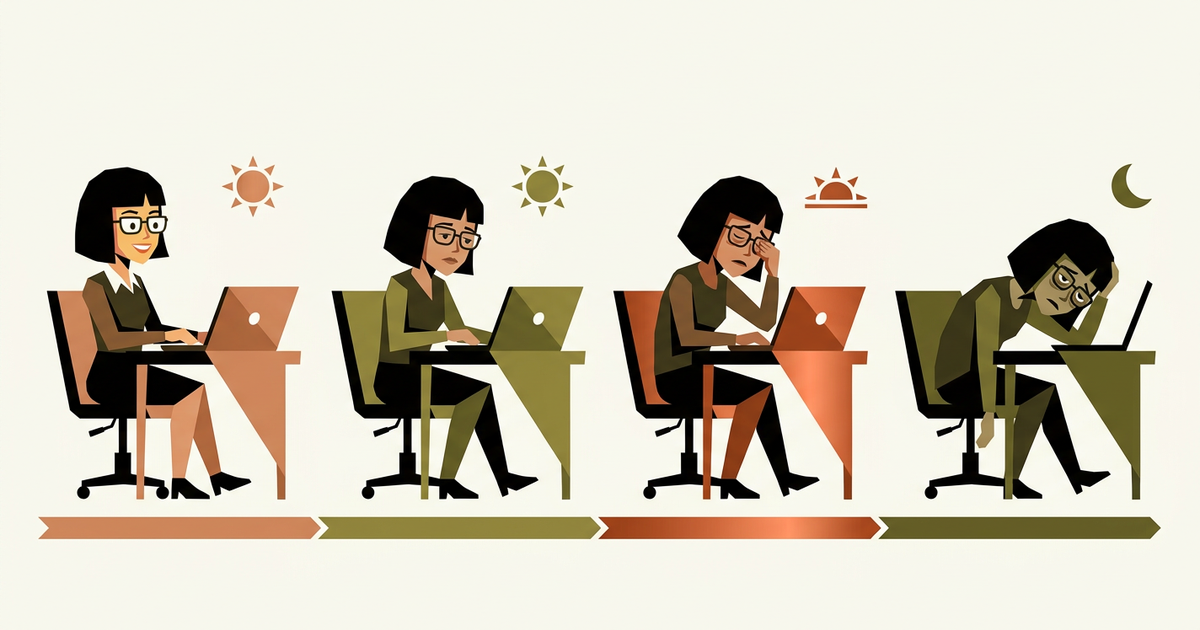
A Day Your Eyes Will Never Forget
Most people don't think about their eyes for eight straight hours. But their eyes are keeping score. Here's the hour-by-hour breakdown.
Hour 0–1: The Calm Before the Storm
The first 30 minutes feel great. Fresh eyes, normal blink rate, sharp focus.
Around minute 30, blink rate drops by up to 60%. Your tear film starts evaporating faster than it's replenished. The surface of your eye is drying out—silently.
Hour 1–2: The Muscles Lock In
Your ciliary muscles have been contracted for a full hour—like holding a bicep curl for 60 minutes straight. This is accommodative stress.
Around 90 minutes, first micro-symptoms appear: subtle tightness, difficulty shifting to distant objects, an unconscious squint. Easy to ignore. But the damage is accumulating.
Hour 2–4: Dryness Compounds
Tear film has thinned significantly. Micro-abrasions form on the cornea. Your eyes produce emergency reflex tears—the watery, irritating kind.
By hour three: gritty eyes, intermittent blurring, redness, the urge to rub your eyes (which makes everything worse).
Hour 4–6: Fatigue Overlaps
Eye fatigue and cognitive fatigue amplify each other:
- Visual processing slows
- Reading speed decreases measurably
- Error rates increase
- Tension headaches begin behind the eyes
The cruel irony? Most people respond by trying harder—leaning closer, squinting more. All of which makes strain worse.
Hour 6–8: The Bill Comes Due
By hour six, your eyes are operating in a degraded state. Accommodation is impaired. End-of-day symptoms hit:
- Blurred vision that persists after looking away
- Heavy, aching sensation in and around the eyes
- Light sensitivity
- Neck and shoulder tension
This is Computer Vision Syndrome, affecting 50–90% of people who work at screens 3+ hours daily.
The Timeline Makes the Solution Obvious
| Time | What Happens |
|---|---|
| 0–30 min | Stable focus, normal blink rate |
| 30–60 min | Blink rate drops, tear film thins |
| 60–90 min | Ciliary muscles locked |
| 2–3 hours | Dry eye onset |
| 4–6 hours | Visual + cognitive fatigue overlap |
| 6–8 hours | Cumulative damage |
Eye strain is cumulative. Without interruption, it compounds all day. The solution is to interrupt the cycle every 20 minutes—before it compounds.
Detox Kit: Your Eyes' Built-In Reset
Detox Kit automates the 20-20-20 rhythm. It sits in your menu bar, tracks work cycles, detects typing, and reminds you at precisely the right intervals.
No pop-ups that steal focus. Just gentle nudges that respect your workflow and protect your eyes.
Your eyes go through a war every workday. Give them an ally.
Keep Reading
- Productivity Culture Is Quietly Destroying Your Eyes — How hustle culture became an eye health crisis.
- The Myth of "I'll Take a Break When I Feel Tired" — Why waiting to feel strain means you're already too late.
- 20-20-20 as a Built-In Reset System — The science behind the rule that actually works.
Protect Your Eyes, Effortlessly
Detox Kit brings the 20-20-20 rule to your Mac with smart, non-intrusive break reminders that respect your workflow.
Download Detox Kit for Mac